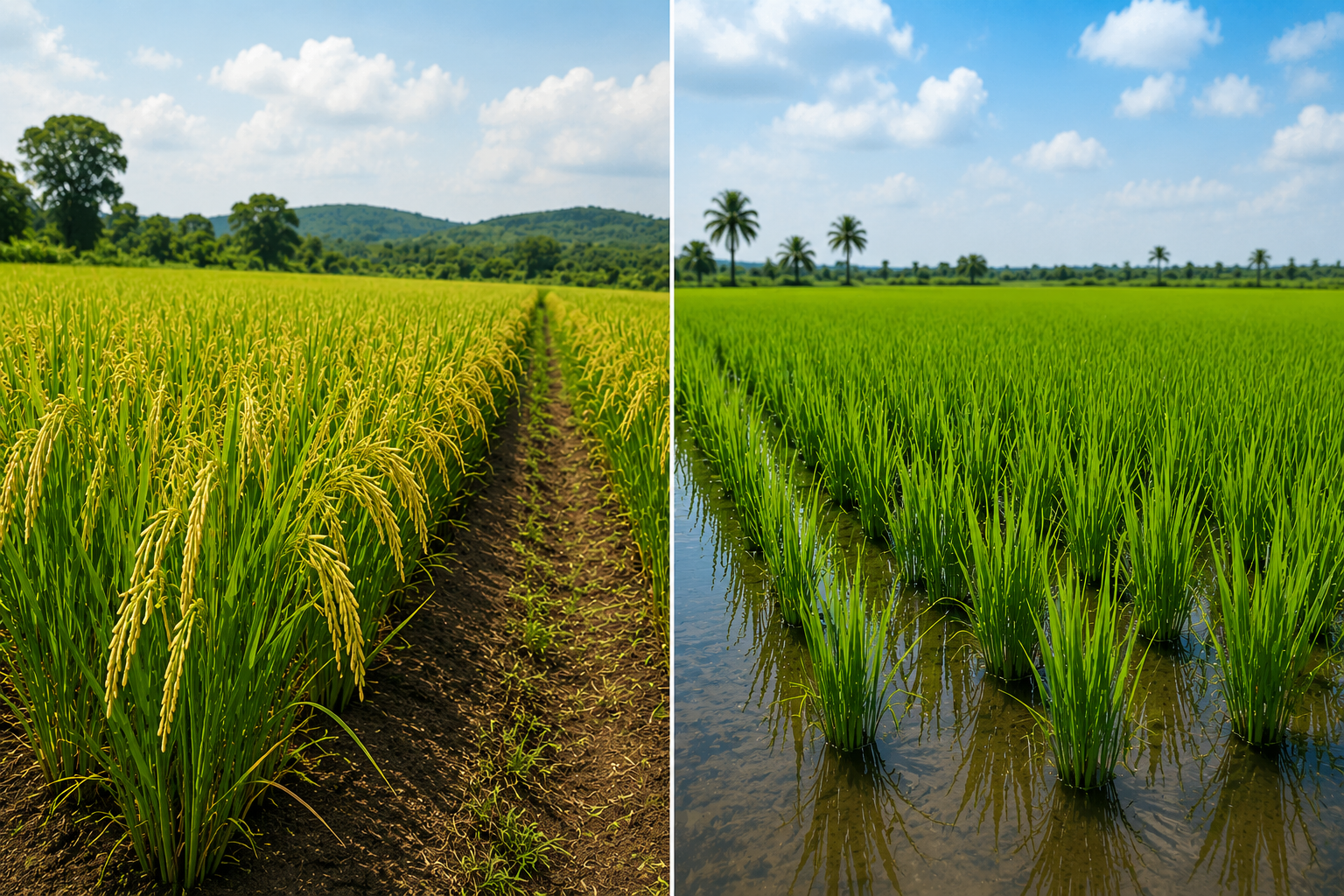
If you’ve ever grown rice and watched it struggle with poor growth, low yields or disease despite your best efforts, one possible reason is that you planted a variety that wasn’t suited to your farm’s growing conditions.
A rice variety that thrives in a flooded paddy won’t necessarily perform well in a rain-fed upland field. Before you prepare your land this season, ask yourself one simple question: Is your farm upland or lowland, and are you planting a variety that’s suited to it?
Upland Rice: Built for Rain-Fed Conditions
Upland rice is grown on well-drained soil without standing water. It depends entirely on rainfall rather than flooding, which makes it the dominant system across much of the North West and North East. Kaduna, Gombe, Taraba, Adamawa and Yobe all have large numbers of farmers working upland fields.
When choosing a variety for upland farming, look for one that’s bred for rain-fed conditions. These varieties are typically:
- Drought tolerant: Able to withstand short dry spells between rains.
- Early maturing: Many upland varieties mature faster, reducing the risk of late-season dry spells affecting the crop.
- Vigorous in early growth: Fast establishment helps the crop compete better against weeds, which are often more aggressive in fields without standing water.
If your farm depends on rainfall and doesn’t have irrigation or natural flooding, an upland-adapted variety will almost always outperform a lowland variety planted under the same conditions.
Lowland Rice: Built for Flooded or Paddy Systems
Lowland rice is grown in fields that are flooded or hold standing water for part of the growing season, either through natural flooding, irrigation or paddy systems. This is common in areas with access to rivers, floodplains or irrigation infrastructure.
If your fields remain flooded or are irrigated for much of the season, choose a variety developed for lowland production. These varieties are generally:
- Adapted to standing water: Able to grow and perform well in flooded or saturated soils.
- Responsive to consistent water supply: Stable moisture allows these varieties to express their full yield potential.
- High yielding under favourable conditions: With reliable water availability, lowland systems often produce higher yields than rain-fed upland systems.
Planting a lowland variety in a flooded field gives you the full benefit of consistent moisture and nutrient availability; something an upland variety isn’t designed to take full advantage of.
What About Farmers Who Do Both?
A significant number of farmers work with both systems, sometimes cultivating upland and lowland rice on the same farm, or switching between them depending on the season and water availability.
If this is you, the key is simple: match the variety to the specific field, not to your farm as a whole. A field that floods needs a lowland variety. A field that depends entirely on rainfall needs an upland variety. Using the same seed across both will almost always mean one field performs below its potential.
Why This Decision Matters More Than It Seems
Choosing the wrong variety for your production system doesn’t just reduce yield, it affects everything that follows:
- Weed management: Upland fields face heavier weed pressure, making timely weed control and vigorous, early-establishing varieties especially important.
- Water use: A variety adapted to flooded conditions may not perform to its full potential in a rain-fed upland field where soil moisture is limited.
- Disease management: Disease pressure differs between upland and lowland systems, so choosing a variety with resistance suited to your production ecology can improve crop performance.
- Harvest timing: Planting a variety with the wrong maturity period can expose the crop to late-season drought or rainfall, reducing yield and grain quality.
Getting this right at the start of the season sets the tone for everything else; from land preparation to weed management to the health of your final harvest.
The Bottom Line
Before you finalize your seed for this planting season, take stock of your field. Does it flood or hold water naturally? Or does it depend entirely on rainfall? That answer should guide your variety choice, not habit, and not whichever seed is easiest to find.
Don’t choose your seed simply because it’s popular or readily available. Choose it because it’s the right variety for your field.
Matching your rice variety to your actual growing system is one of the simplest, lowest-cost decisions you’ll make all season, and one of the ones most likely to pay off by harvest time.
Want more guidance tailored to your farm? Download FarmPropa (available on Android and iOS) for Good Agronomic Practices for rice and product recommendations to help you make better decisions throughout the season.
Leave a Reply