Blog

  • How to Request Products via the FarmPropa App

    How to Request Products via the FarmPropa App

    If you’re part of the Saro community, then you already know the Farmpropa app is a powerful tool. From herbicide calculations to GAPs guidance and helpful blog resources, it supports you at every stage of your farming journey.

    But here’s what many farmers still don’t realise: you can also request your herbicides and other Saro products directly from the app.

    Let’s break it down into four simple steps.

    Step 1: Open the App and Tap “Browse Products”

    Open your Farmpropa app and tap on “Browse Products.” This is where all available products are displayed. Think of it as your Saro Agroscience DP, right inside your phone.

    Step 2: Find and Select the Product You Want

    Scroll through the list and tap on the product you need. Whether it’s an herbicide or any other farm input, simply select it to continue.

    Step 3: Choose the Quantity You Want

    When the product’s micro section pops up, you’ll see its details. Select how many units you want to buy. Just choose the quantity that suits your farm’s needs.

    Step 4: Tap “Add to Cart”

    After selecting the quantity, tap “Add to Cart. That’s it. Your product request has been made, and a member of our Sales team will contact you. If you need more items, repeat the same steps.

    Alternatively, You Can Also Order Through Our Sales Team

    If you prefer speaking directly with someone, we’ve made that easy too.

    Send a WhatsApp message to our number – 09169971208. Please remember to include:

    * Your location

    * The product name

    * The quantity you would like to purchase

    This helps our team process your order quickly and accurately.

    The Farmpropa app was built to make things easier for you. Now, beyond calculations and information, you can also request the trusted Saro products you rely on, all in one place. FarmPropa is now available on the App Store and Google Play Store. Download the app today to get your farming season fully started.

  • 3 Myths About Land Clearing Herbicides and What Farmers Really Need to Know

    3 Myths About Land Clearing Herbicides and What Farmers Really Need to Know

    Land clearing is never just another task on the farm; it’s the start of a season, the first step toward a good harvest. But anyone who has tried knows it’s hard work: weeds fight back, roots cling stubbornly to the soil, and timing is everything. That’s why land-clearing herbicides are so valuable. They can save hours of backbreaking labour and make sure the soil is ready for planting.

    Yet, over time, myths have grown around them. Stories pass from farmer to farmer, from one season to the next, shaping expectations, and are not always true. Some of these misconceptions lead to wasted chemicals, poor land clearing, or even crops struggling later on.

    In this week’s blog, we will be spotlighting those myths, clarifying why they aren’t entirely true, and giving you practical insight so your next land preparation is smooth, efficient, and predictable.

    Myth 1: One herbicide works for every plant

    Many farmers think that once you spray any herbicide, it will kill everything in sight. But plants and chemicals don’t all respond the same way. Some herbicides travel through the whole plant, attacking roots and shoots, while others only work where they touch.

    The reality: Choosing the right type matters. Some herbicides like Glyphosates (Gobara, Gobara SG, Uproot, and Sarosate) go deep, giving thorough control over tough weeds. Others (Glufosinates like Slasher, Slasher Super, and SlashaGold) act better upon touch but may need careful coverage.

    Myth 2: Good herbicides produce immediate results

    It’s easy to get impatient. Spray today, see a bare field tomorrow, that’s what many expect. But herbicides take time to do their work. Some show effect in just a few days, while others need almost a week to fully act.

    The reality: Knowing how fast your herbicide works helps you plan the next steps – whether it’s tilling, planting, or retreating problem spots. Rushing to reapply can waste chemicals, stress plants, and harm the environment. How quickly you see results depends on the herbicide. Glufosinate herbicides (like Slasher, Slasher Super, and SlashaGold) act faster, with visible effects in 3–5 days, while Glyphosate (Gobara, Gobara SG, Uproot, and Sarosate) takes a bit longer, typically 4–7 days to show full results. All in all, no herbicide produces an immediately observable result.

    Myth 3: Rain ruins everything

    Farmers also worry that a little rain will wash away their herbicide. The truth isn’t so simple. Some herbicides become “rainproof” in a few hours, while others take longer. To avoid wash-off, spray on dry days and make sure no rain is expected for the next few hours.

    The reality: Paying attention to weather and how your herbicide behaves can make the difference between a clean field and wasted effort. For instance, Glufosinate herbicides (like Slasher, Slasher Super, and SlashaGold) become rainfast after about 4-6 hours, while Glyphosate (Gobara, Gobara SG, Uproot, and Sarosate) takes roughly about 1-4 hours. In both cases, you have nothing to worry about as long as the specified period is kept.

    In conclusion,

    Herbicides can make land clearing easier, but only when used with knowledge. Understand how they work, give them time to act, respect the rain, and think about the weeds you’re facing. When you do, land clearing stops being a gamble and becomes a smart, predictable step toward a productive farm.

    If you’re looking for trusted solutions, Saro Agrosciences offers a range of herbicides for every need, whether you want something fast-acting or something that goes deep to tackle stubborn weeds. From Slasher and SlashaGold to Gobara and Uproot, there’s a product for every type of land and season. Learning how to choose and use them wisely can save time, reduce effort, and help your farm thrive. That’s why we have the product recommender on the FarmPropa app for you to use.

    Land clearing is just the start, make it count with the right herbicide in hand.

  • Preparing Your Land for a Successful Farming Season

    Preparing Your Land for a Successful Farming Season

    A successful farming season doesn’t start when the seeds go into the ground, it starts long before that, right at the farm. Proper land clearing, tillage, and soil treatment are the first steps to ensuring your crops grow healthy and strong. Let’s break it down in simple steps.

     1. Clearing Your Land

    Before planting, your farm must be free from weeds, old crops, and debris. This helps your new crops get enough sunlight, water, and nutrients. Clearing also reduces places where pests and diseases can hide.

    Tips:

    i. Remove all large plants, roots, and stones.

    ii. Cut down weeds and grass that could compete with your crops.

    iii. Use a hoe, cutlass, or tractor depending on the size of your farm.

    2. Tillage: Preparing the Soil

    Tillage is the process of turning and loosening the soil. It makes the soil soft so roots can grow easily and helps water reach the plants. Proper tillage also mixes in leftover plant matter, which adds nutrients to the soil.

    Tips:

    i. Use a plough, hoe, or tractor for tillage.

    ii. Break large soil clumps to create a fine, even seedbed.

    iii. Avoid over-tilling, which can damage soil structure.

    3. Soil Treatment: Making Your Soil Ready

    Healthy soil grows healthy crops. Soil treatment involves adding fertilizers, compost, or other organic materials to give your plants the nutrients they need. It also balances the soil’s pH and protects against diseases.

    Tips:

    i. Test your soil if possible to know what nutrients it needs.

    ii. Add compost or organic manure to improve fertility.

    iii. Apply recommended fertilizers carefully to avoid burning your crops.

    There’s a Simpler Way…

    While all the steps above are important for creating the right environment for your crops, manual land clearing can be tiring and time-consuming. Thankfully, with the right herbicides, you can reduce the stress of land preparation and avoid unnecessary hard labour.

    Saro Agrosciences offers a range of effective herbicides that help farmers clear their land with ease. Products like Slasher, Slasher Super, Slasha Gold, Gobara, Uproot, and Sarosate are specially formulated to tackle everything from grasses, broadleaves, shrubs and other stubborn weeds. With these solutions, you can save time, cut costs, and preserve your energy for the next stages of farming.

    The best part is that even farmers with small land sizes and limited budgets can benefit. The sachet pack options for these products are cost-effective and still deliver excellent results, making them a smart choice for farmers working with fewer resources.

    Remember, the work you do before planting often determines how successful your harvest will be. Take time to prepare your land properly, and your crops will thank you.

  • No More Guesswork: Here’s How to Start Using Insecticides the Right Way

    No More Guesswork: Here’s How to Start Using Insecticides the Right Way

    If you’ve been farming for even one season, you already know insects don’t joke. One day, your maize is green and shining, the next day, armyworms have turned it into a buffet. Or you’re storing beans, and within a few weeks, weevils start poking holes. Very annoying, right? That’s why insecticides exist, to protect your sweat and hard work.

    But here’s the thing: insecticides are like sharp cutlasses. Very useful, but dangerous if you don’t use them well. Helping you use them well is all we aim to discuss in this blog, but first…

    Why do farmers need insecticides?

    Simple: insects reduce your harvest, reduce your profit, and can even spread diseases. Imagine planting cassava, only for mealybugs to suck it dry, or losing tomatoes to whiteflies just before market day. Painful! Insecticides help stop that. They also keep mosquitoes and houseflies under control at home.

    Different types you’ll find

    Not all insecticides work the same way. Here are the common ones:

    • Contact insecticides – kill insects once they touch them.
    • Systemic insecticides – go inside the plant, so when insects suck or chew, that’s the end.
    • Residual insecticides – stay on the crop or soil for a while, giving you longer protection.
    • Natural insecticides – things like neem-based products. They are softer on the environment and safer for you too.

    How to use insecticides the smart way

    Using insecticides is not just about “mix and spray.” If you want results, here are some golden tips:

    1. Know your enemy. Not every insect is bad. Bees and ladybirds are your friends. Don’t kill your helpers.
    2. Check the label. Every bottle or sachet comes with instructions. Follow it. Don’t think “if I add more, it will work faster.” Overdose can spoil your crops or even harm you.
    3. Protect yourself. Cover your hands, nose, and mouth. Don’t spray against the wind. Safety first, always.
    4. Spray at the right time. Morning or evening is best — the sun is not too hot, and insects are more active.
    5. Keep it safe. Store chemicals far away from children, food, and drinking water.

    Wrapping up,

    Think of insecticides like medicine for your farm. If you are sick, you don’t swallow a whole pack of drugs at once, you take the right dose. Same with your farm. Use the right chemical, at the right time, in the right way. That’s how you protect your crops, harvest more, and smile to the market.

  • The reasons you are loosing money after harvests and how to avoid them.

    The reasons you are loosing money after harvests and how to avoid them.

    For many farmers, harvest is the happiest time of the season. But it can also be the most frustrating. You’ve worked hard and invested time and money, yet after selling your crops, you realize the money isn’t enough. This happens more often than you think, and the reasons are not always bad farming. Many times, the loss comes after the harvest.

    The good news is with a few changes, you can protect your effort and increase your income. Here’s how.

    1. Protect Your Crops with Better Storage

    Poor storage is one of the biggest silent thieves of farm profit. Grain gets eaten by weevils, cassava spoils, and tomatoes rot. By the time you take them to market, you’ve lost a good portion.

    What you can do:

    * Dry grains properly before bagging.

    * Raise bags off the ground with wood or stones to avoid dampness.

    * Use improved storage bags or silos if you can afford them. Even simple practices like sealing bags tightly or keeping stores clean can save you a lot.

    2. Avoid Selling in a Rush

    It’s normal to want quick cash at harvest. School fees, debts, and household needs push many farmers to sell everything immediately. Unfortunately, that’s when the market is flooded and prices are lowest.

    What you can do:

    * Sell a small portion immediately for urgent needs.

    * Keep the rest in storage and sell later when prices rise.

    * If possible, join farmer cooperatives. Selling in bulk gives you stronger bargaining power.

    3. Handle Transport with Care

    Sometimes the loss is not in the farm, but on the road. Bags tear, fruits squash, or trucks overload, making the harvest half-spoiled by the time they arrive.

    What you can do:

    * Use the right packaging (plastic crates for tomatoes instead of raffia baskets).

    * Avoid overloading vehicles.

    * If hiring transport, remind handlers to treat your produce with care—because every bag is money.

    4. Know Your Market Before You Sell

    Many farmers depend on middlemen who dictate prices. Without market information, you might end up selling too cheap.

    What you can do:

    * Ask fellow farmers about current prices.

    * Listen to radio programs or use apps (where available) that share daily market rates.

    * Build direct relationships with buyers such as millers, traders, or processors.

    Wrapping up,

    Farming is not just about planting and harvesting. It’s also about planning what happens next. Think of it this way: your farm doesn’t pay you in crops, it pays you in cash from the crops. The more you protect, store, and sell wisely, the more your hard work truly pays off.

    Remember, small improvements like better storage patient selling, and careful transport can mean the difference between just surviving and truly earning from your farm.

  • How to Get Your Farm Ready for Dry Season Farming

    How to Get Your Farm Ready for Dry Season Farming

    In Nigeria, the farming year doesn’t end with the rains. The dry season usually sets in around late September in some regions and early November in others. For many farmers, this change is seen as a resting period, but the truth is that dry-season farming can be one of the most rewarding times of the year. Crops that are scarce during these months often sell at premium prices, and farmers who prepare early are the ones who reap the benefits.

    The challenge is that dry season farming requires a different kind of planning. Unlike the rainy season, when nature helps you with water and soil moisture, the dry season demands more from you as a farmer. That’s why preparing early, before October, is the smartest move you can make. Here are some practical steps to help you get your farm ready.

    1. Secure Your Water Source Early

    Water is the lifeline of dry-season farming. If your farm doesn’t have a reliable water source, it will be very difficult to succeed. This is the time to check your borehole, stream, river, or irrigation canal. If you rely on pumps, pipes, or tanks, make sure they are in good working condition before planting begins. Farmers who wait until November often face delays or even lose weeks of planting time because of broken pumps or long queues for water. Remember: crops don’t wait.

    2. Pick the Right Crops for the Season

    Not every crop is suitable for the dry season. Focus on crops that mature quickly and are in high demand during these months. Tomatoes, peppers, onions, leafy vegetables, and maize are some of the most common and profitable choices. These crops usually fetch higher prices because supply is limited in the dry season while demand remains high. Choosing wisely can be the difference between breaking even and making a solid profit.

    3. Prepare Your Land Before the Rains Stop

    Land preparation is often overlooked, but it plays a big role in how well your crops perform. Don’t wait until the rains are completely gone. Start clearing, ploughing, and ridging your land early. This gives you time to add organic manure or compost, improve the soil structure, and treat against pests and diseases before planting. Farmers who prepare early usually face less stress later and have crops that establish better once planted.

    4. Stock Up on Inputs Before the Rush

    Every farmer knows that once the dry season approaches, prices of seeds, fertilizers, and agrochemicals begin to climb. Fake products also start flooding the market. September is the perfect time to buy your inputs; not only do you save money, but you also reduce the risk of getting substandard materials. Waiting until everyone else is buying often leaves you with higher costs and fewer options.

    5. Plan Your Market Before You Plant

    One of the biggest mistakes farmers make is to focus only on planting and leave marketing for later. Farming doesn’t end in the field; it ends when your crops are sold. Before you plant, take time to talk to local buyers, traders, processors, or even neighbors who might need your produce. Having a ready buyer ensures you won’t be forced to sell at throwaway prices when your crops mature. Think of it as planting with a clear destination in mind.

    6. Take Advantage of Dry-Season Opportunities

    Dry-season farming may sound like hard work, but the opportunities are huge. This is the season when vegetables are scarce, when fresh maize fetches double its usual price, and when households are willing to pay more for quality produce. With proper preparation, you not only keep your farm active but also create a steady flow of income while others are waiting for the rains to return.

    If you take these steps now, you’ll position yourself to harvest profit when others are winding down. The dry season may look challenging, but with good preparation, it can be your most productive season of the year. We wish you all the best!

  • Catch Black Pod Early. Protect Your Cocoa. Save Your Farm.

    Catch Black Pod Early. Protect Your Cocoa. Save Your Farm.

    Black pod disease is one of the biggest threats to cocoa production across West Africa. Many farmers have seen healthy pods turn black almost overnight, losing a large part of their harvest. The truth is, black pod is dangerous, but it can be managed if spotted early.

    In this blog, we’ll show you how to identify the first signs of black pod, understand how it spreads, and share simple steps you can take to protect your farm.

    What is Black Pod Disease?

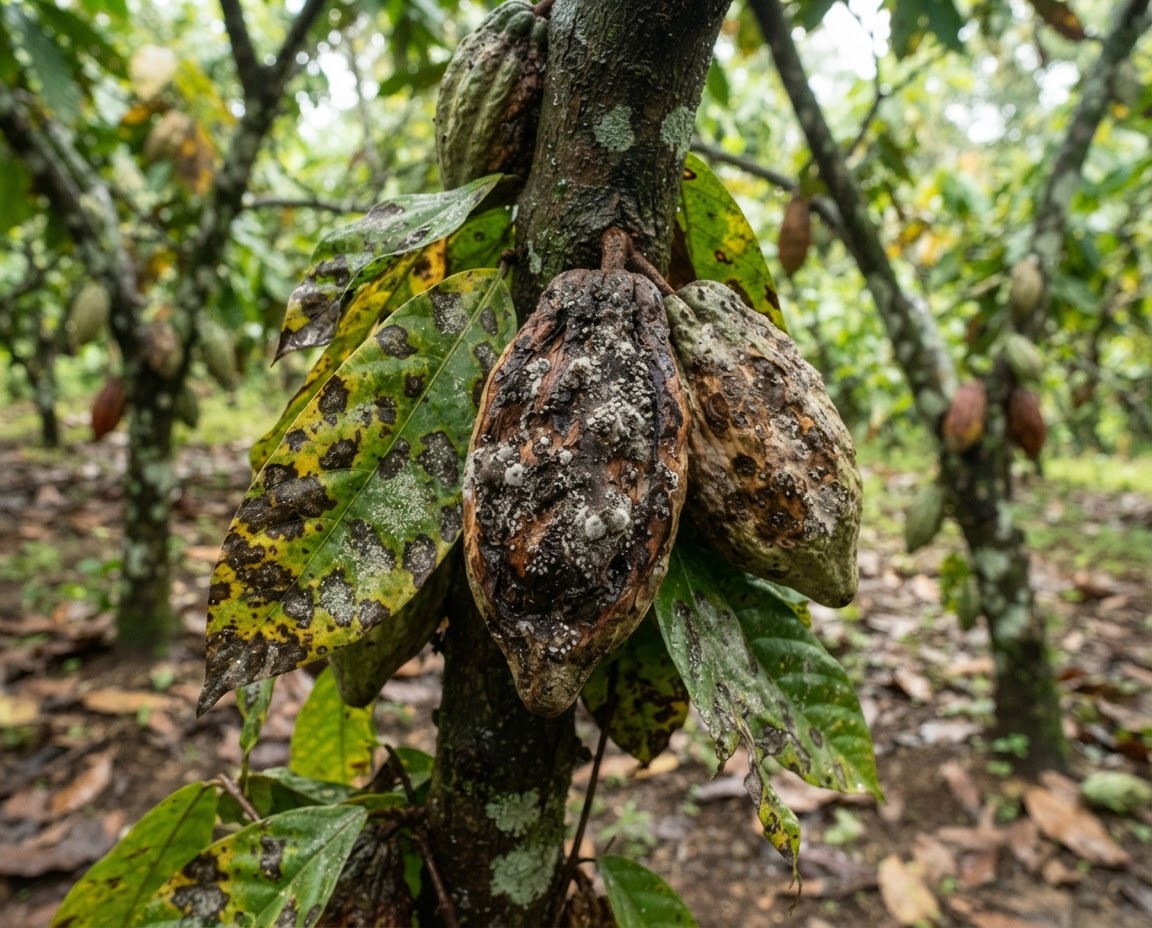
    Black pod disease is caused by fungi from the Phytophthora group. These fungi thrive in warm, wet, and humid conditions, exactly the kind of weather cocoa grows best in. Once the fungus infects a pod, it rots quickly and becomes useless for processing.

    If not controlled, black pod can destroy 30% to 90% of your harvest in one season.

    Why Early Detection is Important

    Every farmer knows prevention is cheaper than cure. The earlier you notice black pod, the easier and less costly it is to control. Waiting too long means:

    1. More pods get infected.
    2. Sprays become less effective.
    3. You risk losing a big share of your income.

    Early Signs of Black Pod to Look Out For

    When walking through your cocoa farm, check your pods carefully. Here are the main things to watch for:

    1. Brown or dark spots on green pods.

    2. Water-soaked or soft areas as if the pod has been bruised.

    3. Rapid blackening (the brown patch spreads until the pod turns fully black).

    4. Rotting before maturity (i.e., pods spoil while still young).

    5. White fungal growth (in very humid or rainy conditions, you may see a white layer of fungus on the infected pod).

    If you notice any of these signs, act immediately.

    What to Do if You Spot Black Pod

    Here are simple steps to control black pod early:

    * Remove and destroy infected pods: cut off infected pods and bury them away from the farm.

    * Prune and weed regularly: keep the farm clean and airy to reduce humidity.

    * Spray fungicides correctly: use recommended fungicides at the right intervals, especially during the rainy season. For cocoa, we recommend Mackeknie Gold or Mackeknie Extra for controlling black pod infection in cocoa.

    * Harvest frequently: don’t leave ripe pods hanging too long.

    * Improve drainage: avoid stagnant water around your farm.

    Long-Term Prevention

    * Plant resistant cocoa varieties where possible.

    * Train your workers to identify early symptoms.

    * Stick to a seasonal fungicide program, not just emergency spraying.

    * Practice farm hygiene throughout the year.

    Wrapping up,

    Black pod is a tough enemy, but it’s not unbeatable. By checking your pods regularly, acting fast, and maintaining good farm practices, you can protect your cocoa and secure your harvest.

    Remember: a few minutes of inspection today can save you months of hard work tomorrow.

  • 5 Land clearing myths that could be costing you money (Here is the Truth)

    5 Land clearing myths that could be costing you money (Here is the Truth)

    When people hear “land clearing,” they usually picture bulldozers ripping through forests or farmers setting the entire fields on fire. For some, it’s the villain of environmental destruction. For others, it’s simply a quick, no-questions-asked step before farming or construction.

    The truth is more complex. Land clearing isn’t inherently bad, it’s the methods and management that make all the difference. Misconceptions, especially about herbicides and other clearing practices, often cloud the conversation and lead to harmful choices on the ground.

    Let’s break down some of the most common myths and uncover what really works.

    Myth 1: Land clearing is always destructive

    The word “clearing” tends to paint a mental image of bulldozers flattening everything in sight. But not all land clearing is reckless. Methods such as selective clearing (removing only specific trees or bushes), mulching, and the use of targeted herbicides can prepare land while protecting soil structure, reducing erosion, and preserving valuable vegetation. Sustainable land clearing is not about wiping land bare; it’s about making land usable without stripping it of life.

    Myth 2: Burning is the cheapest and best way to clear land

    Across many farming communities, bush burning remains the go-to method of clearing. It’s fast, requires minimal equipment, and appears to be cost-effective. But the hidden costs are heavy: nutrient loss in the soil, release of carbon emissions, and destruction of beneficial organisms. While it may feel cheap in the moment, burning often reduces land productivity in the long run. Alternatives, such as controlled use of herbicides, are safer for both the soil and the surrounding environment, which brings us to the next point.

    Myth 3: Herbicides ruin the land

    Herbicides often have a bad reputation, typically due to stories of misuse, such as spraying excessively, ignoring recommended guidelines, or using unapproved products. The truth is, when used correctly, land-clearing herbicides are a controlled and effective tool. They suppress unwanted vegetation without destroying soil structure, unlike burning or repeated tillage.

    At Saro Agrosciences, we are committed to ensuring that our farmers have access to only the best and safest products. Hence, the reason we constantly reassess and improve our active ingredients. Currently, with some of our land-clearing herbicides, specifically, Slasher, Slasher Super, and Slasher Gold, we have replaced the previous active ingredient (Paraquat) with a safer and more environmentally friendly option (Glufosinate), to keep you and your crops safe while still saving labour, improving efficiency, and making land preparation more sustainable.

    Myth 4: Manual clearing is always the safer option

    Manual methods; using cutlasses, hoes, or slashers, are often said to be the “natural” way to clear land. But they can be labour-intensive, slow, and impractical for large areas. Over-clearing manually can also expose soil to erosion if not done carefully. A balanced approach that combines manual clearing for sensitive areas and herbicides or mechanical methods for broader spaces is often more efficient and sustainable.

    Myth 5: Once the land is cleared, the job is done

    Clearing is only the first step. Without follow-up measures, newly cleared land can degrade quickly. Effective land management requires soil conservation practices, cover cropping, and careful monitoring to prevent invasive weeds from reestablishing themselves. Sustainable land use means thinking beyond the initial clearing and planning for long-term productivity.

    Wrapping up,

    Land clearing is not inherently bad, it’s the practices around it that determine whether it’s destructive or sustainable. Herbicides, when properly applied, can play a valuable role in modern land preparation. By moving past myths and embracing responsible practices, farmers, communities, and policymakers can ensure that land clearing supports growth without costing the environment.

  • How to Achieve Better Harvest with Crop Rotation

    How to Achieve Better Harvest with Crop Rotation

    Modern farming is no longer just about planting, harvesting, and repeating the cycle. The soil itself needs attention, and one of the oldest yet most effective strategies to keep it productive is crop rotation. This practice, when done right, not only improves yield but also results in healthy soil.

    In this week’s blog, we break down how crop rotation improves soil health and why it should form a key part of your farming schedule.

    1. Breaking Pest and Disease Cycles

    When farmers grow the same crop year after year (a practice called monocropping), pests and diseases that attack that crop quickly build up in the soil. For example, if you plant maize continuously, maize stalk borers and soil-borne diseases will increase over time.

    By rotating crops – say, cereals with legumes or tubers, you disrupt the cycle. Many pests and pathogens that thrive on one crop simply can’t survive when another replaces it. This natural break reduces infestations and disease pressure, meaning farmers can spend less on pesticides and enjoy healthier crops.

    2. Natural Soil Fertility Boost

    Different crops draw nutrients differently. Cereals consume lots of nitrogen, tubers like cassava demand potassium, and vegetables have their own nutrient needs. Rotation helps balance this usage so the soil doesn’t get exhausted. For instance, planting maize after soybean or cowpea often results in better yields because the maize benefits from the nitrogen left behind in the soil.

    3. Improving Soil Structure and Organic Matter

    Soil is a living system. Continuous monocropping drains it of organic matter and weakens its structure. Rotation helps restore balance. Deep-rooted crops open up the soil, improving aeration and water infiltration, while crop residues decompose into organic matter that strengthens soil texture and moisture holding capacity.

    4. Preventing Soil Erosion

    Rotating with crops that provide ground cover protects soil from erosion. Their canopy shields the surface from raindrop impact, while their roots hold the soil together, preserving valuable topsoil where nutrients are most concentrated.

    5. Promoting Biodiversity in the Soil

    Healthy soil is alive with organisms, bacteria, fungi, earthworms, and other microfauna. Crop rotation, especially with legumes, introduces different root exudates and organic materials that feed a diverse community of soil organisms. This biodiversity helps suppress harmful pathogens, enhances nutrient cycling, and keeps the soil ecosystem resilient.

    Practical Crop Rotation Ideas

    • Maize–Soybean Rotation: Farmers who rotate maize with soybean often see higher maize yields due to improved nitrogen and reduced disease pressure.
    • Cassava–Groundnut Rotation: Cassava’s high nutrient demands are supported by groundnut’s soil-enriching effect.
    • Rice–Vegetable Rotation: Upland rice rotated with tomatoes, peppers, or leafy vegetables improves soil structure and reduces rice-specific disease cycles.
    • Yam–Cereal Rotation: Alternating yam with cereals helps cut down yam pests and balances nutrient use.
  • Herbicides and Legumes: Do’s and Don’ts Every Farmer Should Know

    Herbicides and Legumes: Do’s and Don’ts Every Farmer Should Know

    Farming legumes like beans, soybeans, or groundnuts is rewarding, but weeds can destroy the effort made; they steal water, sunlight, and nutrients from your crop, leaving you with poor harvests. That’s why using herbicides the right way is very important.

    At Saro Agrosciences, Buster (a pre-emergence herbicide you use after planting but before weeds come up) and Twig (a post-emergence herbicide you use when weeds are already showing). are very effective in helping to protect your legumes at the right time, but only if you apply them correctly.

    Here are the dos and don’ts every farmer should know and adhere to before their next herbicide application on a leguminous farm.

    The Do’s (What You Should Do)

    1. Use the right herbicide at the right stage: Before planting, make sure you clear the field with land-clearing herbicides like Slasher, Slasher Super or Gobara SG. These are non-selective herbicides, which means they kill every plant they touch. That’s why they must be used before planting, if you spray them after, they will wipe out your crop completely.

    Right after planting your legumes, apply Buster quickly to stop weeds from coming up and to keep the field clean from the start. If you miss this early application window, don’t worry. Wait until the weeds show, then use Twig to clear them safely without harming your beans, soybeans, or groundnuts.

    Remember: timing is everything. Using these herbicides at the wrong stage will not only reduce their effect but can also harm your crop. Follow the right order, and your farm will thank you with a better harvest.

    2. Measure and mix correctly: STRICTLY follow the instructions on the label when it comes to dosage. Using the right amount is the only way to get the best results. If you use more than required, you will not get a better outcome; instead, you risk destroying your crops and harming the soil and environment. On the other hand, if you use too little, the weeds will survive, and all your effort and money will be wasted.

    The simple rule is this: don’t guess, don’t underdo, don’t overdo, just follow the instructions on the label.

    3. Spray at the right time of day: Spray in the morning or evening when the sun is not too hot, the wind is calm, and no rain is expected. This helps the herbicide work better and reduces waste.

    The Don’ts (What You Should Avoid)

    1. Don’t mix herbicides carelessly: Unless the label or an expert says it is safe, never combine two different herbicides. Wrong mixtures can destroy your crop or reduce effectiveness. If you must mix, make sure to reach out to us for more details.

    2. Don’t forget to wear PPE while spraying: Always wear boots, gloves, and a face cover. Wash your sprayer, hands, and clothes immediately after spraying. Protecting your health is as important as protecting your crops.

    3. Don’t keep herbicides near food, children, or animals: store them separately in a safe, dry place. Herbicides are dangerous if swallowed or touched.


    In conclusion,

    Herbicides are great. But how you apply them is just as important as the product itself. Want more tips, simple guides, and expert advice on protecting your crops? Download the FarmPropa App today and carry knowledge with you everywhere you go.